The Wheel
Pirate Parties don't have a platform per se. They have a philosophy. Here's the difference.

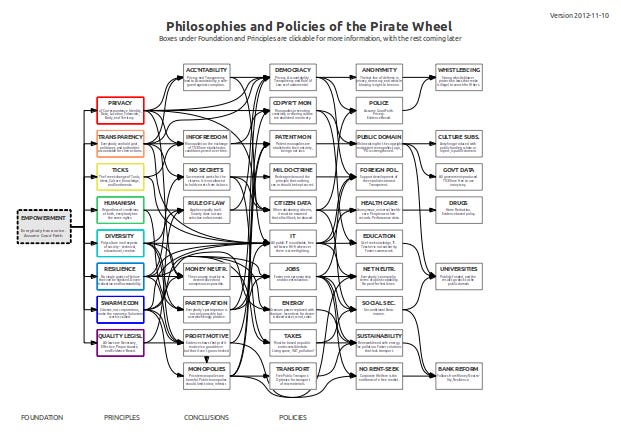
Every political party in America has a platform. Most of them read like someone stapled together the minutes from three different committee meetings, argued about the wording for six months, and called the result a philosophy. You get a list of positions. Gun stuff. Tax stuff. Healthcare stuff. No explanation of how any of it connects. No way to figure out what the party would think about an issue that isn’t on the list.
The Pirate Party has something different. It’s called the Pirate Wheel.
The Wheel isn’t a list. It’s a policy tree — a set of principles you can actually derive positions from, on any issue, including ones that didn’t exist when the framework was written. The structure matters. It’s the difference between a party that has opinions and a party that has a philosophy.
Here’s how it works.
The Hub: Empowerment
At the center of the Wheel is a single observation: everybody now has a voice, and nobody can be silenced.
That’s it. That’s the starting point.
The printing press changed what information could be distributed. The industrial revolution changed who could manufacture things. The internet changed who could be heard. Every one of those shifts rewrote the power balance in society. The current one is the internet shift, and it’s still in progress — and most governments are still operating as though it hasn’t happened.
The consequence of everyone having a voice is that the old model of government — where you needed interpreters, gatekeepers, and official spokespersons because it was physically impossible to listen to everyone — is obsolete. The gatekeepers haven’t left, of course. They’ve just lost their justification.
The Pirate position is that when everyone is empowered, government has to change its operating assumption. Not “all citizens are potential suspects until proven otherwise.” Instead: assume good faith. Build systems that expect people to take responsibility, and they will. Build systems that expect everyone to cheat, and they will do that instead. This isn’t idealism. It’s behavioral observation.
Everything else in the Wheel derives from this.
The Eight Spokes
1. Privacy
Your body, your communications, your data, your money, your location, your identity — yours. Not conditionally yours. Not yours until someone in authority decides they need a look. Yours.
The Pirate standard for when privacy can be violated is specific: a dedicated law enforcement authority, acting on concrete, prior, individual suspicion of a specific serious crime that has already been committed. All four conditions have to be met simultaneously. “Someone might do something” doesn’t cut it. Neither does “we want to check.” Neither does a warrant covering everyone in a ZIP code.
Most current surveillance law fails this standard by design. The Pirate Wheel is clear about what that makes it.
2. Transparency
Here’s the asymmetry that most people miss: privacy and transparency are not opposites. They’re not in tension. They apply to different actors.
Individuals get privacy. Institutions get transparency.
You have the right to your own correspondence. The government does not have the right to its own correspondence — not when it’s acting in your name. Every action, every justification, every dollar. Available to any person who asks, without having to show ID, without paying a fee, without explaining why they want it.
Whistleblowers who expose what publicly funded institutions are doing — including private contractors doing public work — are protected. No exceptions. Anyone can be a journalist. The information doesn’t need to go to an approved outlet to matter.
3. Ticks
Ticks is an acronym: Tools, Ideas, Culture, Knowledge, Sentiments. It covers everything that can be communicated — software, art, music, scientific research, printable designs, opinion, emotional response. All of it.
The Pirate position on Ticks is that their free exchange is what builds civilization. Downloading, using, remixing, and sharing — all of it should be not just permitted but actively encouraged. No permits. No conditions. No licenses that expire or that can be revoked by whoever happened to fund the work twenty years ago.
This is where Pirates come from, historically. Copyright law has been steadily extended for a century to serve the interests of a shrinking number of rights holders at the expense of everyone else. Patent law has become a weapon for suppressing competition rather than encouraging invention. The AI training data fight is the latest version of the same argument. The Pirate position hasn’t changed: intellectual monopolies are rights-limiting, not rights-granting.
4. Humanism
Everybody has the same rights regardless of where or when they were born, what they look like, who they sleep with, or what they believe. The state doesn’t prefer one religion, one political worldview, or one set of unfalsifiable claims over another.
The distinction the Wheel draws here is between born traits (race, gender, sexual orientation, time and place of birth — not chosen) and acquired beliefs (religion, politics, philosophy — chosen). Both categories get protection. Neither gets state preference.
Policy is based on peer-reviewed, falsifiable, secular science. Not on what feels morally correct to whoever is currently in charge. The two are different things, and the difference matters.
5. Diversity
Monocultures are fragile. One vulnerability in a technical monoculture and every system goes down simultaneously. One dominant ideology and the society loses its ability to correct course. One approved institutional structure and you’ve built a single point of failure into the entire civilization.
Pirate policy favors polycultures at every level — technical, ideological, institutional. This isn’t about celebrating difference for its own sake. It’s about the structural reality that diverse systems survive and homogenous systems fail. California has watched this play out in agriculture, in tech, and in finance. The pattern doesn’t change.
6. Resilience
Societies fail in predictable ways. Centralized infrastructure fails during disasters. Centralized power structures get captured by whoever wants them badly enough. The drift toward corporatism, toward surveillance states, toward what we might charitably call managed democracy — these aren’t accidents. They’re failure modes that appear whenever a system has bottlenecks.
The Pirate answer is decentralization to the citizen level wherever possible, combined with a widespread culture of refusing unjust orders. The first makes centralized capture harder. The second makes it survivable.
7. Swarm Economy
The industrial employment model — one job, one employer, full time, for life — is done. It’s not coming back. California knows this better than anywhere. The gig economy is a chaotic, exploitative version of the transition the Wheel describes, where the structural shift has happened but the policy framework hasn’t caught up.
What’s already visible: the most significant productive work of the last twenty years happened outside the employment model. Linux. Wikipedia. Open-source software that now runs most of the internet. The industrial model can explain none of it. It simply would not have been produced by a company pursuing quarterly returns.
The Pirate position is that this volunteer, networked production is real economic activity and should be treated as such — with policy supporting guaranteed sustenance rather than forcing people back into employment structures that no longer fit reality.
8. Quality Legislation
Most legislation is bad. Not politically bad. Technically bad. Internally contradictory, evidence-free, written to satisfy a special interest with a complaint rather than to solve a problem anyone actually has.
The Wheel sets five criteria that every law — new or existing — has to meet:
Necessity. There’s a real, identifiable problem that it’s in the public interest to solve through legislation. Sourced numbers, not comparative adjectives. “Worse than before” is not a problem statement.
Effectiveness. The proposed solution actually solves the identified problem, according to multiple independent studies. Not according to the industry that benefits from the law.
Proportionality. The law doesn’t create worse problems than it solves. Human rights are always in the proportionality calculation.
Evidence-based. Secular, independent, peer-reviewed. Never dogma.
Rights basis. The justification ultimately lands in human rights. Not in morals. Not in tradition. Human rights.
Laws that don’t meet these criteria should be repealed. There are a lot of them.
Why a Wheel
The shape is the point. A wheel has a hub and spokes. Pull out one spoke, and the wheel still rolls. The spokes support each other — Privacy and Transparency together produce accountability; Transparency and Resilience together produce what the Wheel calls “No Secrets,” the condition where sunlight is the structural antibody against institutional rot.
More importantly, the wheel moves. New issues come up — AI, cryptocurrency, synthetic biology, whatever’s next — and you don’t need a committee to decide the Pirate position. You derive it. Starting from Empowerment, through whichever spokes apply, running it through Quality Legislation at the end. The position is there. It was always there.
A flat platform is a list of answers. The Wheel is a way of asking questions.
That’s the difference.
The California Pirate Party is a political party organized around digital rights, government transparency, and civil liberties. We’re building toward ballot access in California — and in the meantime, we’re doing the work. If this framework resonates with you, join the crew or subscribe to stay in the loop.
Questions, arguments, pushback: info@capirates.org